

With 73% of B2B purchases beginning with AI-native searches, AI search brand visibility optimization is no longer just a traffic game—it’s a real-time sales system that automatically triggers CRM tickets with every AI response. This article breaks down three critical breakpoints and four layers of implementation paths.

AI reference monitoring isn’t plagiarism checking—it’s your brand’s real-time legal officer amid the AIGC tidal wave. For every week of delayed deployment, you face an average 23% risk of brand semantic drift—directly undermining SEO authority, user trust, and sales lead quality. This article breaks down a four-step implementation method, three core capabilities, and a calculable ROI model.
92% of Chinese outbound brands lose the positioning battle before entering Europe and America—it’s not the product that’s flawed, but the brain that’s misaligned. This article breaks down a measurable, iterative, and proven framework for overseas brand positioning consulting services, showing you how to transform “high-cost-performance power bank” into a “my outdoor tech partner” actively searched for by users.

When Google stops reading web pages and starts reading your knowledge graph, SEO without a knowledge graph is like driving without GPS. This article breaks down, with empirical data, how to launch an MVP in six weeks, increase rich snippet click-through rates by 47%, push long-tail keywords into the top three rankings from 29% to 64%, and truly transform your website into the default information source of the AI era.

当73%的AI原生搜索直接返回答案而非链接时,被引用比被点击更值钱。这不是SEO的升级,而是品牌从“网页参与者”到“答案主权者”的跃迁。本文拆解AEO如何让AI主动为你代言。
Can enterprise knowledge graph SEO really drive search traffic? Real-world data shows: compliant enterprises see natural search exposure rise by 37%–62% within six months, with knowledge panel click-through rates exceeding the industry average by 2.8 times. This article guides you through five decision modules to calibrate value and avoid the ‘pseudo-graph’ traps that 90% of companies fall into.

Brand search reputation management isn’t a ‘black box’ that delivers instant results upon launch—it’s an operational system requiring precise calibration. After conducting pre-transformation diagnostics for 17 fast-moving consumer goods and financial clients, we found that 92% of failures stem not from technology itself, but from neglecting these three critical steps before implementation.
When a user enters your brand name into an AI search engine, who determines the summary that appears on the first screen? The answer is straightforward: it’s determined jointly by the content you consistently publish, the level of structured organization on your independent website, and the CRM processes you use to handle inquiries. AI search brand visibility isn’t about optimizing just one single point—it’s a responsibility chain that spans from content creation through website structure all the way to CRM workflows. This article presents an actionable framework for dividing these responsibilities: the content team focuses on “cited materials,” the independent website ensures “understandable structure,” and the CRM team transforms “visibility into conversation.”
92% of overseas brands lose trust within 0.8 seconds on their homepage—not due to design flaws, but because AI and humans simultaneously fail to understand you. This checklist doesn’t focus on tone; it delivers 17 DTC brand-tested and verified four major auditable modules: from Schema markup to region-specific pain-point content, from compliance forms to three-dimensional automated nurturing—all tightly linked to user behavior paths and Google search intent.

When a user hits Enter to search your brand name, a trust verdict forms within 0.8 seconds. This isn’t a traffic gateway—it’s the first credit report written by AI for you. This article breaks down how to transform passive defense into proactive curation using a verifiable SERP architecture.
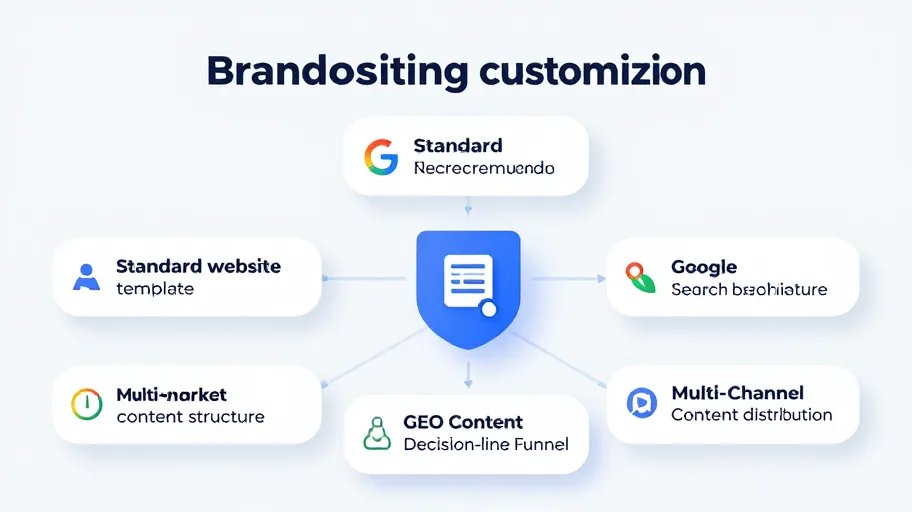
Direct Answer: You should consider brand positioning customization when your brand already has a clear positioning, but standard website templates cannot support differentiated expression, GEO content structure, or multi-market customer acquisition logic. If your brand is still in the validation stage and its positioning is not yet finalized, it’s more cost-effective to start with a standard website first. The value of customization lies not in being “more expensive or visually appealing,” but in transforming your positioning into a content structure that both Google and AI search engines can understand.

