
AI is rewriting the rules of the branding game. Companies that fail to restructure their cognitive frameworks risk losing at least 40% of their market responsiveness within three years. This article breaks down the evolutionary path from static tags to dynamic co-performance, using real data to show why leading brands have already made AI their brand brain.
When a user asks, “Which smartwatch is worth buying?” AI responds directly with “Apple Watch Series 9”—while your brand isn’t mentioned at all. It’s not about ranking—it’s about disappearing completely. Behind this lies a new rule: AI doesn’t search web pages; it constructs answers.
AI no longer guides users to click—it directly provides answers. If your brand isn’t cited, it’s as good as non-existent. 78% of AI responses don’t even mention brand names—this isn’t a traffic issue; it’s a crisis of perception.
AI-powered CRM is no longer just an automation tool—it's a sales accelerator capable of predicting customer behavior and making autonomous decisions. It's reshaping enterprise customer management with a 35% efficiency boost and a 28% reduction in customer churn.
The core of enterprise AI customer acquisition isn’t tool stacking—it’s system coordination. By integrating GEO, intelligent CRM-based customer acquisition, and proprietary channels, you can achieve quantifiable pathways that boost lead conversion rates by 30%+.

Whether a business needs an AI CRM depends on one straightforward criterion: when sales and customer data are scattered across multiple tools, manual follow-ups can't keep pace with the growth of leads, and the team cannot answer the question "Which customers are most worth investing in?"—that's when an AI CRM becomes worth considering. If existing processes still support the current business rhythm, optimizing those workflows before introducing new tools is often more cost-effective than jumping straight into purchasing. This article provides a practical decision-making framework, methods for defining implementation scope, and acceptance criteria to help international brands clarify their needs before making a decision.
Your store is clearly on the street, yet users still can't find it? GEO Content Strategy is rewriting local promotion rules. From Baidu to Gaode, AI no longer just scans keywords—it understands your real services. We break down the most effective practical approaches since 2023.

90% of SME brand investments go to waste—not because of poor execution, but because they start off on the wrong track.
The answer lies not in creativity, but in systems.
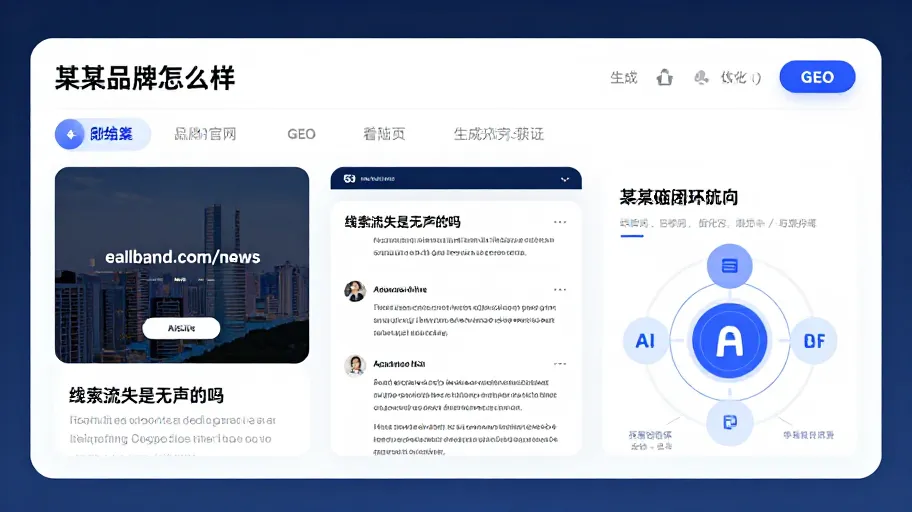
When users increasingly ask "How is brand X?" to AI assistants instead of starting with a search engine, the battleground for brand building has gained another layer. Will your brand be correctly understood, accurately paraphrased, and prioritized by AI? This is no longer a problem that traditional SEO can fully address. This article provides a pragmatic decision-making path: first clarify requirements, then define the implementation scope, and finally use an acceptance checklist to verify whether the investment is worthwhile.
Traditional SEO has failed, and traffic has plummeted—not because you’re not doing enough, but because the rules have changed. AI search no longer matches keywords; it recommends answers. Can your brand still be “seen”?
Traditional SEO is failing. With 60% of traffic cut off by AI answer boxes, your brand may just be 'data fodder.' The real competition is becoming an authoritative entity trusted by AI systems.

